IELTS Writing Task 1 Flow Charts
Process Diagram Guide, Samples & PDF
Master IELTS Writing Task 1 flow chart and process diagram questions with this complete guide. Learn the key task requirements, high-band vocabulary, model answers and practical tips – then practise online with instant feedback.
About IELTS Writing Task 1 Flow Charts
In IELTS Academic Writing Task 1, you are sometimes given a flow chart or process diagram instead of a graph or table. The question usually asks you to summarise the information and describe the main stages of a process.
A flow chart tests whether you can describe stages in a logical order, explain how something works, use process language (e.g. is heated, passes through), and summarise the overall purpose.
Assessment Criteria
Timing & Rules
- Recommended time: 20 minutes
- Minimum length: 150 words
- Common instruction: "Summarise the information by selecting and reporting the main features."
Useful Vocabulary & Patterns
To score Band 7+, avoid repeating simple verbs. Use a variety of precise process verbs, sequencing words, and nouns.
Process Verbs
Describing: show, illustrate, depict, outline
Movement: pass through, enter, circulate, be channelled
Function: serves to, enables, is used to
Sequencing
Start: first, firstly, in the first stage
Middle: then, next, subsequently, following this
End: finally, ultimately, in the final step
Common Nouns
Parts: chamber, section, trench, passage, pipe
Objects: container, lid, device, unit
Elements: heat, smoke, air, fuel, combustion
| Pattern Type | Example Sentence |
|---|---|
| Passive Voice | Fresh air is drawn into the trench; logs are burned to create heat. |
| Cause & Result | Logs are burned; as a result, hot smoke is produced. |
| Overall Purpose | Overall, the system uses a wood fire to produce smoke for preserving food. |
| Linking Stages | After passing over the fire, the smoke moves through a pipe. |
Band 9 Flow Chart Sample Answer
Flow Chart Question
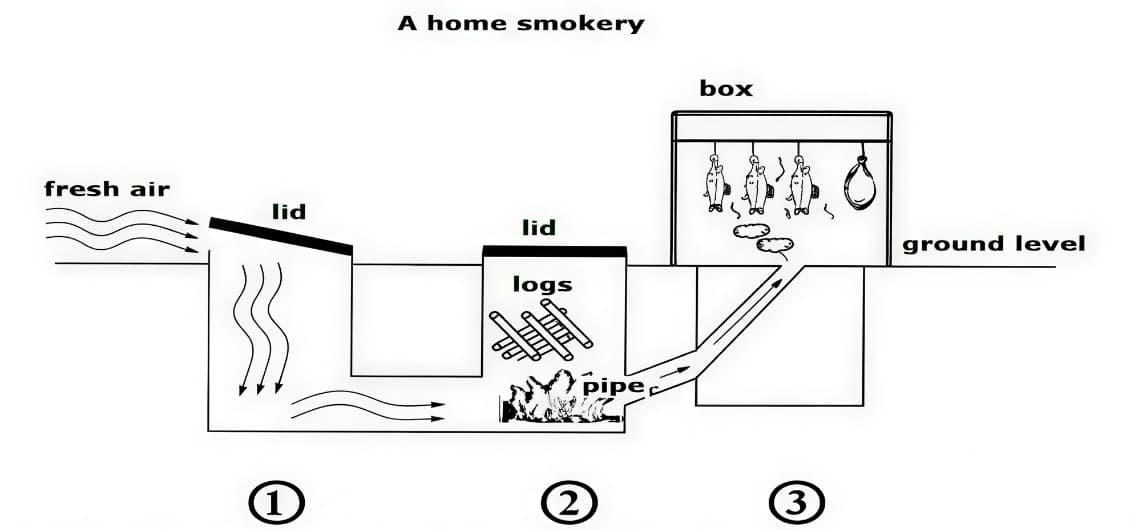
The diagram below describes the structure of a home smokery and how it works.
Summarise the information by selecting and reporting the main features, and make comparisons where relevant.
Planning Notes
- Overall purpose: A device for smoking food at home.
- Structure: Underground inlet/trench, central fire pit, covered passage, above-ground box.
- Process: Air enters → Logs burn → Smoke travels → Food preserved.
The diagram illustrates a simple home smokery used to preserve food such as fish or meat. Overall, the system relies on a small wood fire built below ground level to generate smoke, which is then channelled into a box above ground where the food is exposed to it.
In the first stage, fresh air enters an underground trench on the left-hand side. This shallow compartment is covered by a lid and leads to a second, slightly deeper section in the centre. Here, logs are placed and burned, producing heat and smoke. The trench layout ensures that air is drawn steadily through the system towards the fire, allowing the combustion to continue.
From this central fire pit, the smoke flows along a covered passage towards the final chamber. A pipe carries it up into a box positioned at ground level, inside which pieces of food are hung from the roof. Once the smoke reaches this box, it circulates around the food before escaping, gradually flavouring and preserving the contents.
In summary, the home smokery is a straightforward yet effective device that uses natural airflow and an underground fire to direct smoke into a container, where it can be used to smoke food safely and efficiently.
Writing Tips for Flow Chart Essays
1. Task Response
Always include an overview explaining the purpose. Do not give opinions or reasons unless shown.
2. Coherence & Cohesion
Group information logically. Use sequencing phrases (first, next, finally) and follow the arrow direction.
3. Language Use
Use present simple for processes. Use passive voice when the actor is unknown (e.g. "is heated").
Practise Flow Chart Task 1 with Lingoleap
Use this page together with Lingoleap to turn theory into real exam practice. Draft your answer, get instant AI evaluation, and use high-band rewriting tools.
Open Practice EditorFAQs about Flow Charts
Related IELTS Writing Task 1 Pages
Detailed AI Feedback
Get instant scoring and detailed corrections for your IELTS essays with LingoLeap Premium.
Try for Free