IELTS Writing Task 1 Line Chart
Line chart questions require you to describe changes over time, highlight main trends, and compare categories clearly. Master this task with our Band 9 samples, vocabulary lists, and AI-powered practice tools.
What Is an IELTS Writing Task 1 Line Chart?
A line chart question tests your ability to visualize data trends over time. You must identify main features rather than listing every single number.
Assessment Criteria
- Task Achievement:Summarise main features & provide an overview.
- Coherence:Organise logically (Intro, Overview, Body).
- Lexical Resource:Use precise trend vocabulary.
- Grammar:Accurate complex sentences & punctuation.
Timing & Rules
- Recommended time: 20 minutes
- Minimum length: 150 words
- Common instruction: "Summarise the information by selecting and reporting the main features."
Useful Vocabulary & Patterns
To score Band 7+, avoid repeating "increase" and "decrease". Use a variety of precise verbs and adverbs.
rise, increase, climb, grow
Strong: surge, soar, rocket, jump
fall, decrease, decline, drop
Strong: plunge, plummet, slump, crash
remain stable, stay constant, level off, plateau, stabilize
| Term / Pattern | Examples |
|---|---|
| Surge / Soar / Rocketverb |
|
| Plummet / Plunge / Slumpverb |
|
| Significantly / Dramaticallyadverb |
|
| A followed by Bpattern |
|
Band 9 Sample Answer
Analyze this high-scoring response to understand paragraph structure and data selection.
Changes of TV prices and income
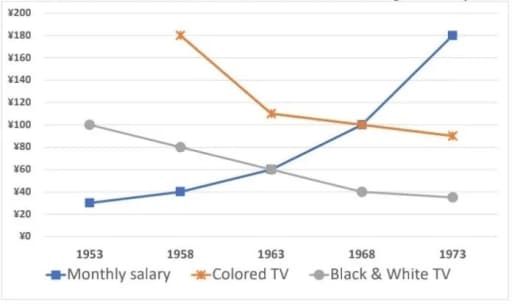
The chart illustrates the evolution of average monthly salaries and the prices of black and white, as well as color televisions in Japan from 1953 to 1973. This period witnessed significant economic and technological transformations, which are reflected in the data.
To begin with, there was a remarkable increase in the average monthly salary over the two decades. In contrast, the prices of televisions, both black and white and color, experienced a notable decline.In 1953, the average salary was approximately 30,000 Yen, which surged to nearly 180,000 Yen by 1973. This sixfold increase indicates robust economic growth. Such an upward trend in income levels is indicative of Japan's post-war economic miracle.
Concurrently, the price of a black and white TV fell from 100,000 Yen in 1953 to roughly 35,000 Yen by 1973. Similarly, color TVs, introduced later (in 1958), saw their prices plummet from 180,000 Yen to 80,000 Yen. This downward trend made these products increasingly accessible to the average consumer as the gap between income and prices narrowed.
Essential Writing Tips
Task Response
Always include a clear overview paragraph highlighting the main trends. Do not just list data points mechanically; group them logically.
Common Pitfalls
Avoid writing a conclusion that repeats the overview. Do not give personal opinions or explain "why" the trends happened unless the chart says so.
Data Selection
Select key features: start/end points, peaks, lows, and intersections. Use approximations (e.g., "just under", "roughly") to sound natural.
Practice Area
Challenge yourself with a random question.
Random Question Generator
Public Transport Usage
The chart below shows the number of passengers using three different modes of public transport in a European city between 1990 and 2020.
Q: How many paragraphs?
Ideally 4: Introduction, Overview, Body 1, Body 2.
Q: Can I use "I"?
No, keep it objective. Use "The chart shows..." not "I can see...".
IELTS Writing Task 1 Sample Answers (Band 7–9)
The Number of Visitors to the Main Attractions (Million)
The chart below shows the number of visitors for five kinds of tourism attractions in a European city in 1981, 1991 and 2001.
Urban Population in Four Different Countries
The graph shows percentages of urban population in four different countries between 1970 and 2030.
Forestry Industry Productions in a European Country
The graph below shows three productions in the forestry industry in a European country from 1980 to 2000. Summarise the information by selecting and reporting the main features, and make comparisons where relevant.
IELTS Writing Checker
If you would like to practise IELTS Writing Task 1 & 2 with instant AI feedback, you can use Lingoleap, an AI-powered platform designed for IELTS and TOEFL learners.
On Lingoleap’s IELTS page, you can:
- Generate and practise Writing Task 1 and Task 2 questions
- Get AI scoring and corrections on your essays, including feedback on task response, coherence, vocabulary and grammar
- Build your own bank of sample answers and vocabulary for different IELTS topics
- Combine writing practice with integrated speaking, reading and listening tools